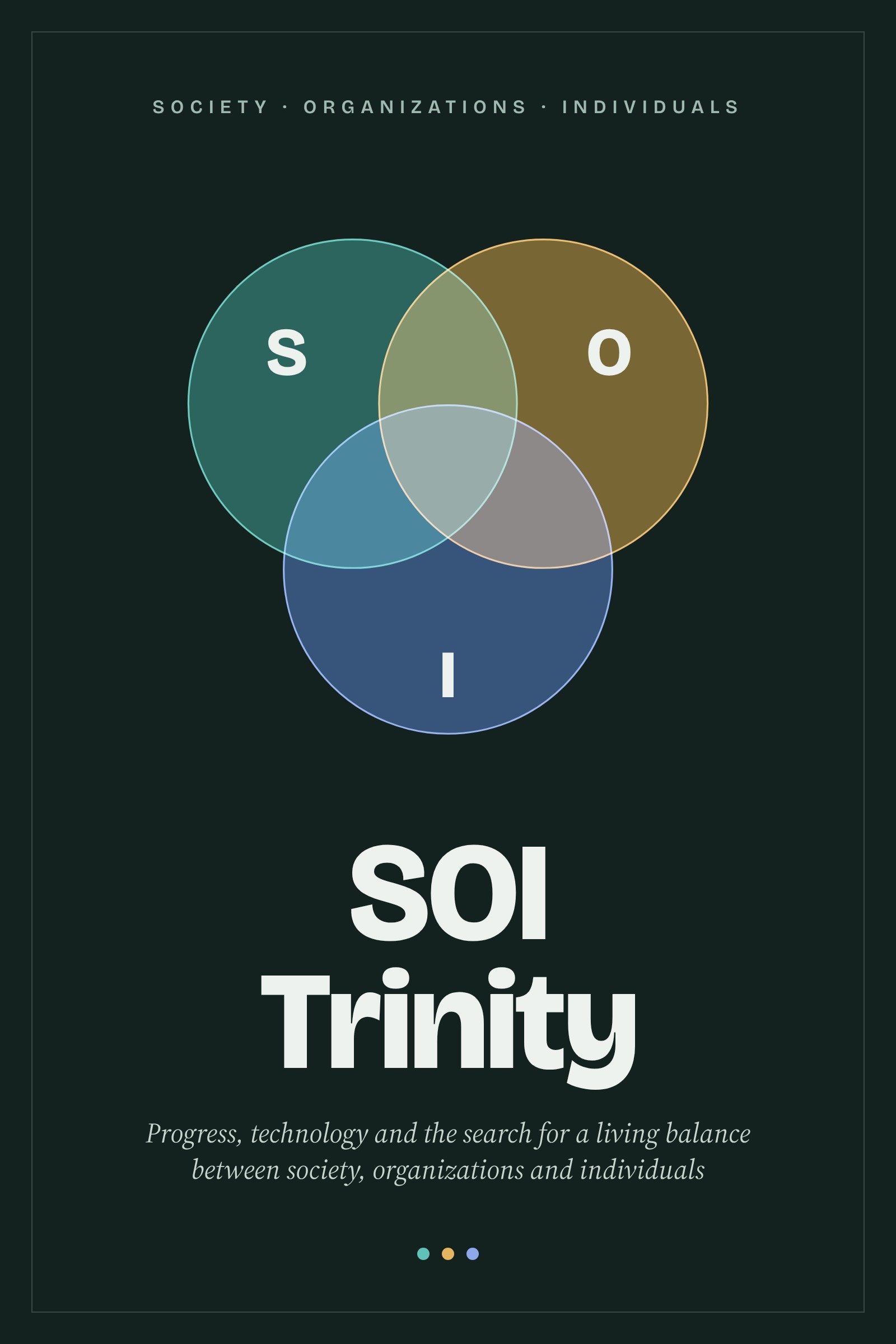
SOCIETY · ORGANIZATIONS · INDIVIDUALS
A framework for moving through the AI revolution without losing balance
SOI Trinity sees society, organizations and people as one living organism. When technology transforms one part, it transforms all three. We help you see that movement clearly and act from awareness rather than haste.
THE FRAMEWORK
Three entities, one organism
Each entity pursues its own good. When one grows at the expense of the others, the whole system falls out of balance. SOI Trinity looks at all three at once, measures where we are and maps the path towards a sustainable state of peace.
Society
Public services, administration, the functions of the state and institutions. Its value function is the common good: governance, equity and long-term sustainability.
Organizations
Companies, NGOs and communities that create value. Their value function is innovation and continuity, and their impact reaches everyone.
Individuals
Each person, with body, mind and meaning. Their value function is wellbeing, dignity and the freedom to choose how to live.
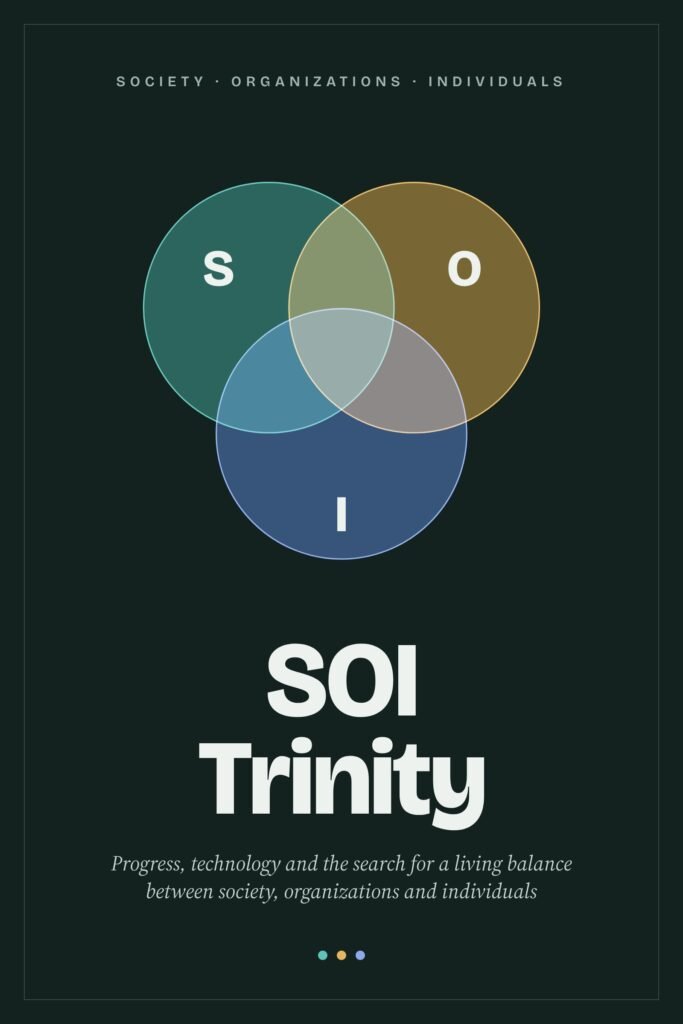
THE BOOK · COMING SOON
SOI Trinity
Progress, technology and the search for a living balance between society, organizations and individuals
An essay that re-examines the idea of progress inherited from the Enlightenment, reads the present through technological revolutions and offers practical tools to align the three entities that shape our lives.
The SOI Trinity – A Systemic Organism
This chapter introduces the SOI Trinity framework, a systemic model designed to help individuals, organizations, and societies navigate the profound changes brought by technological revolutions, particularly the ongoing AI revolution. The SOI Trinity identifies three core entities (Societies, Organizations, and Individuals) as interconnected agents of change, each with unique roles, motivations, and impacts. By analyzing these entities through dimensions such as innovation, governance, and personal well-being, the framework provides a structured approach to understanding the ripple effects of technology on human life and civilization. It emphasizes the need for critical thinking and holistic adaptation to balance the competing value functions of these entities, ensuring that technological progress aligns with ethical principles, sustainability, and human dignity. Ultimately, the SOI Trinity serves as a tool for fostering awareness, collaboration, and resilience in the face of rapid and complex transformations.
A philosophical comment on global vision of progress
This chapter critically reexamines the Enlightenment-rooted ideal of progress, revealing its internal contradictions and unintended consequences. While it has fueled unprecedented scientific, economic, and political transformations, its rationalist and technocratic underpinnings have also fostered ecological degradation, cultural marginalization, and existential disconnection. The dominant linear and universalist narrative (anchored in control, measurement, and abstraction) is increasingly challenged by alternative frameworks that emphasize relationality, ecological balance, and epistemic plurality. In place of a one-dimensional model, the chapter advocates for a reimagined, multidimensional vision of progress attuned to planetary wellbeing, cultural depth, and the complexity of human experience.
Understanding the present through the lens of Technological Revolutions
This chapter explores the profound societal transformations driven by technological revolutions, emphasizing the current digital and AI era. It highlights how technology, from ancient tools to modern AI, has consistently reshaped human life, economies, and cultural norms, often with both empowering and disruptive consequences. By examining historical shifts, the chapter underscores recurring patterns of innovation, resistance, and adaptation. It delves into the ethical dilemmas and systemic changes brought by technology, framing it as a force that not only enhances capabilities but also redefines values, power structures, and human identity. Drawing on historical insights like Schumpeter’s “creative destruction”, it underscores the need for thoughtful governance to balance innovation with sustainability and equity. The chapter calls for critical reflection to navigate the accelerating pace of technological transformation responsibly.
Bridging concept with practical use
This chapter introduces the “Solution Assess Circle,” a structured framework for evaluating the impact of technological and AI-driven changes on the SOI Trinity. It outlines a dynamic process for identifying current states (“as is”), envisioning future optimal states (“to be”), and mapping the steps needed to bridge the gap. The framework emphasizes continuous adaptation, critical thinking, and collaboration across societal, organizational, and individual dimensions. By integrating tools like gap analysis, scoring impacts, and strategic roadmaps, the Solution Assess Circle provides a practical approach to navigating the complexities of technological revolutions and achieving systemic balance.
Threshold for Continuous Alignment
The Peace Formula is introduced as a roadmap for achieving equilibrium across the SOI Trinity, emphasizing quality of life and systemic harmony. It combines value-based principles with potential mathematical modeling to identify imbalances and guide actions toward a balanced state. The chapter underscores the importance of managing abundance rather than scarcity, fostering peace at individual, societal, and organizational levels. By integrating emotional, mental, and economic well-being, the Peace Formula provides a holistic approach to navigating technological revolutions and building a sustainable future. It highlights the interconnectedness of all entities and the need for continuous alignment to adapt to evolving circumstances.
WHO WE ARE
Founders
SOI Trinity grew out of the meeting of business, technology, philosophy and therapeutic practice. Two different paths with one shared question: how can we live and organize ourselves in peace in times of accelerating change?
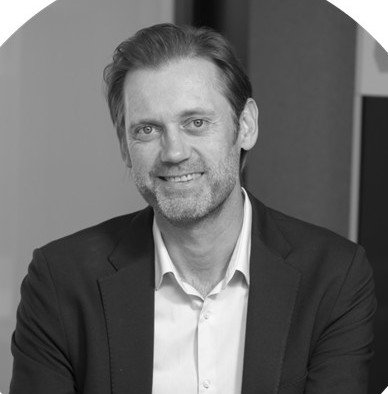
Frode Huse Gjendem
Previous Chief Data & AI Officer· Integrative therapist · Barcelona
«Understanding the impact of technological revolutions means embarking on a path of learning about the technologies themselves and about their impact on society and on individuals»
Over 26 years at Accenture (1997–2023) he worked in data analytics, artificial intelligence, management consulting and IT outsourcing. He led several transformations, most recently in AI and analytics, and headed a team of 450 data scientists and engineers across the Americas, Europe and APAC.
His focus has always been on building intelligent and human organizations that can implement, scale and benefit from technology. That question, how technology affects organizations and people, led him to psychology. Since 2023 he has worked as a therapist, leads meditation retreats with Bosque Serenæ and develops SOI Trinity, a framework for anticipating the adaptations needed to live in peace during a technological revolution.
Education:
- MsC in Economy and Business Admistration, NHH (Bergen)
- Bachelor in Logistics Molde University
- Gestalt Therapy (Escuela Gestalt Terra)
- Sexual Therapy (SOMA)
- Buddist Meditatation

Carlota Conde Soria
Philosopher · Consultant Researcher · Madrid
«Building dialogue and bridges for human flourishing in today’s technological revolution.»
Carlota develops thought leadership on innovation and technology through an ethical lens, contributing content and subject-matter expertise while encouraging research that reaches beyond traditional boundaries. Combining ethical perspective on technology with hands-on experience in PMO, research and strategic planning, helping agents turn innovation into positive impact measurable outcomes. Her work spans the public and private sectors.
She is especially driven by the human side of tech & AI transformation. She combines strategic research, trends and foresight with a strong focus on AI-driven transformation and new ways of working, always grounded in Responsible AI and digital ethics. Her work fosteres a collaborative, symbiotic environment where innovation can flourish and deliver meaningful societal outcomes.
Education:
- Degree in Philosophy, Complutense University of Madrid
- Gestalt Therapy (EMTG) and Integrative Psychotherapy
- Enneagram, Claudio Naranjo’s SAT Programme

CONTACT
Let’s talk
Would you like updates on the book, to invite us to speak, or to apply the SOI Trinity framework in your organization? Write to us.
We can help with
- Talks and workshops
- Support for organizations
- Leadership counceling and team events
- Individual counceling
© 2026 SOI Trinity · Frode Huse Gjendem and Carlota Conde Soria